How I Made ~$950 in Just 2 Minutes (Without Predicting the Market)
By Harsh Shah · Updated
Disclaimer: This article is for educational purposes only and should not be considered financial advice. Options involve significant risk and are not suitable for every investor. Always do your own research before making any investment decisions.
Every investor wishes they knew exactly where a stock would go next. If we all had that ability, investing would be easy. The reality, however, is very different. Nobody knows what a stock will do tomorrow — not me, not Wall Street, and certainly not even the largest hedge funds. Every investment is simply a probability, not a certainty.
Over the years, I’ve stopped trying to predict the market. Instead, I focus on building positions where the risk-reward is tilted in my favor. If I can create a trade that gives me multiple ways to succeed, I’m far more comfortable investing, even when the short-term direction is uncertain.
That mindset led to one of my recent Amazon trades. With less than two minutes remaining before the market closed (around 12:58 PM PT), I executed a trade that generated nearly $1,000 in option premium. It wasn’t a last-minute gamble or a spur-of-the-moment decision. The execution took less than two minutes because the analysis, planning, and risk assessment had already been done.

That’s exactly the mindset I had when looking at Amazon after its earnings report.
The Setup
A few days before Amazon reported earnings, I already had a plan. Looking at the long-term chart, I had identified a major trendline support around $215. Historically, Amazon has repeatedly found buyers around this area, especially whenever the stock traded below its 200-day EMA. Every time that happened, long-term investors who were patient were eventually rewarded.
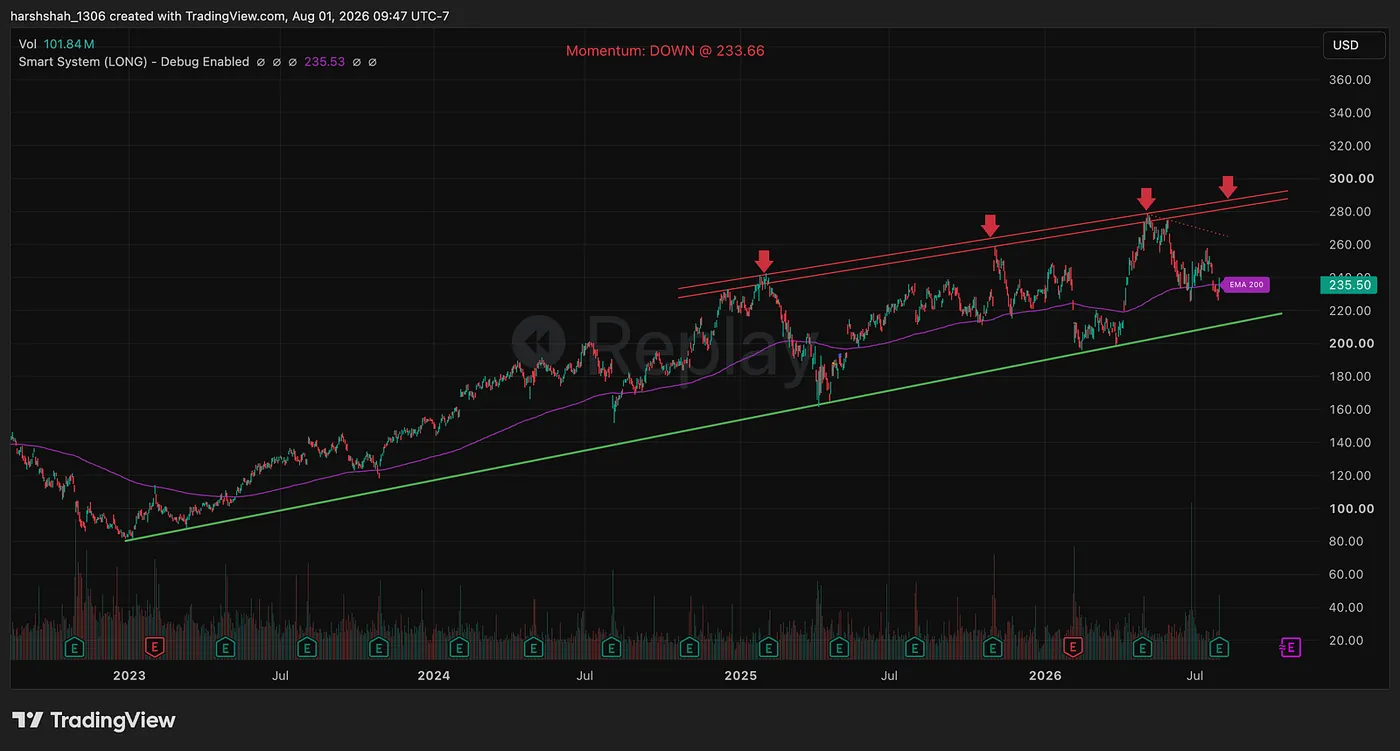
Of course, history never guarantees the future. Just because a stock has respected a level multiple times doesn’t mean it always will. But investing is about probabilities, and based on Amazon’s long-term chart, I believed that area represented an attractive risk-reward opportunity.
At that point, I had two choices.
Choice 1: Simply Buy the Shares
This is what most investors would probably do.
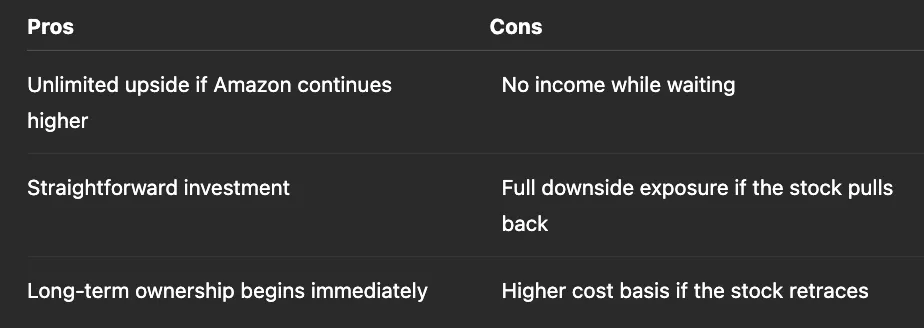
There is absolutely nothing wrong with this approach. In fact, if Amazon kept rallying, this would have produced the highest return.
The problem was that I didn’t know if that would happen.
Choice 2: Buy the Shares and Hedge the Entry
Instead of relying entirely on the stock moving higher, I could use options to improve my position from day one.
This second approach fit my investing style much better.
Rather than trying to predict whether Amazon would rally another 5% or pull back 5%, I could structure my position so that I benefited from several different outcomes. If the stock stayed flat, I would earn option income. If it declined modestly, the premium would reduce my cost basis. And if it continued higher, I would still make a profit — just with my upside capped beyond the strike price.
That trade-off was one I was more than happy to make.
Before We Continue: What Is a Covered Call?
If you’ve never heard of a covered call, don’t worry. The name sounds far more complicated than the strategy actually is.
Let’s break it down with a simple example.
Imagine you own a house worth $500,000. A neighbor comes to you and says:
“I’ll pay you $5,000 today for the right to buy your house from you at $500,000 anytime over the next month.”
You now have a decision to make.
If you think your house is unlikely to increase dramatically in value over the next month, accepting that offer might make sense. You collect the $5,000 immediately, and if nothing changes, you simply keep both the money and your house.
If the house suddenly becomes worth $550,000, your neighbor can still buy it from you for the agreed price of $500,000. You still make money, but you miss out on some of the additional upside.
That is essentially how a covered call works.
You already own the shares, and in exchange for receiving an option premium today, you give someone else the right to buy those shares from you at a specific price before a certain date.
You’re getting paid for making that agreement.
It’s called a covered call because you already own the underlying shares. If the option is exercised, you simply deliver the shares you already have — there’s no additional risk of having to buy them in the market.
My Thesis Before Earnings
Before Amazon even reported earnings, I had already thought through multiple scenarios.
My preferred entry was around $215, where the long-term trendline and historical support came together. If the stock had pulled back to that level, I would have been happy simply buying the shares and holding them for the long term.
But I also asked myself another question:
What if Amazon reports great earnings and gaps higher?
If that happened, I didn’t want to completely miss the opportunity just because my ideal entry never arrived.
At the same time, I also didn’t want to chase the stock after a huge move without acknowledging the increased short-term risk.
That’s where my second plan came in.
Instead of waiting indefinitely for $215 — or blindly buying at $235 — I decided I would buy the shares but immediately hedge the position by selling a covered call.
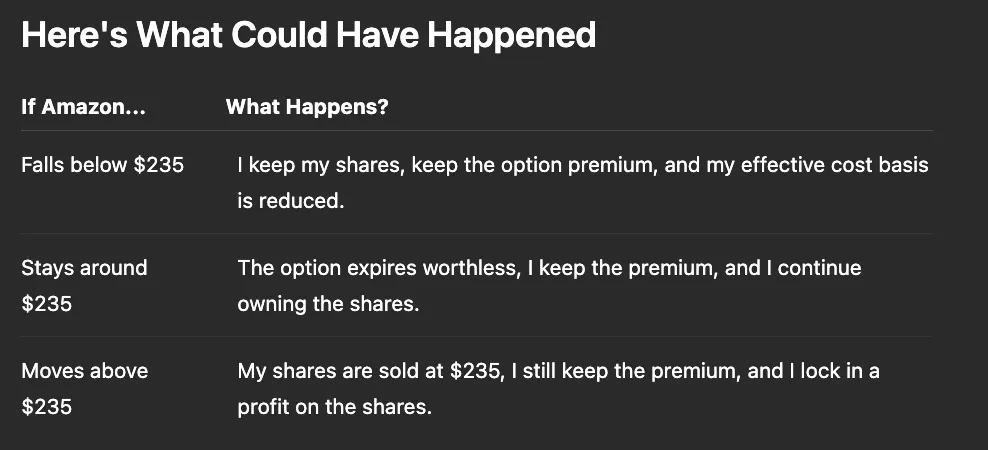
In other words, I wasn’t trying to maximize returns.
I was trying to improve my risk-reward.
That’s an important distinction.
Too many investors spend their time asking, “Where will the stock go next?”
I prefer asking, “How can I structure my position so that I’m comfortable regardless of what happens next?”
That mindset is what led me to take this trade.
What Happened Next?
As it turned out, Amazon kept rallying and closed around $272 the following day.
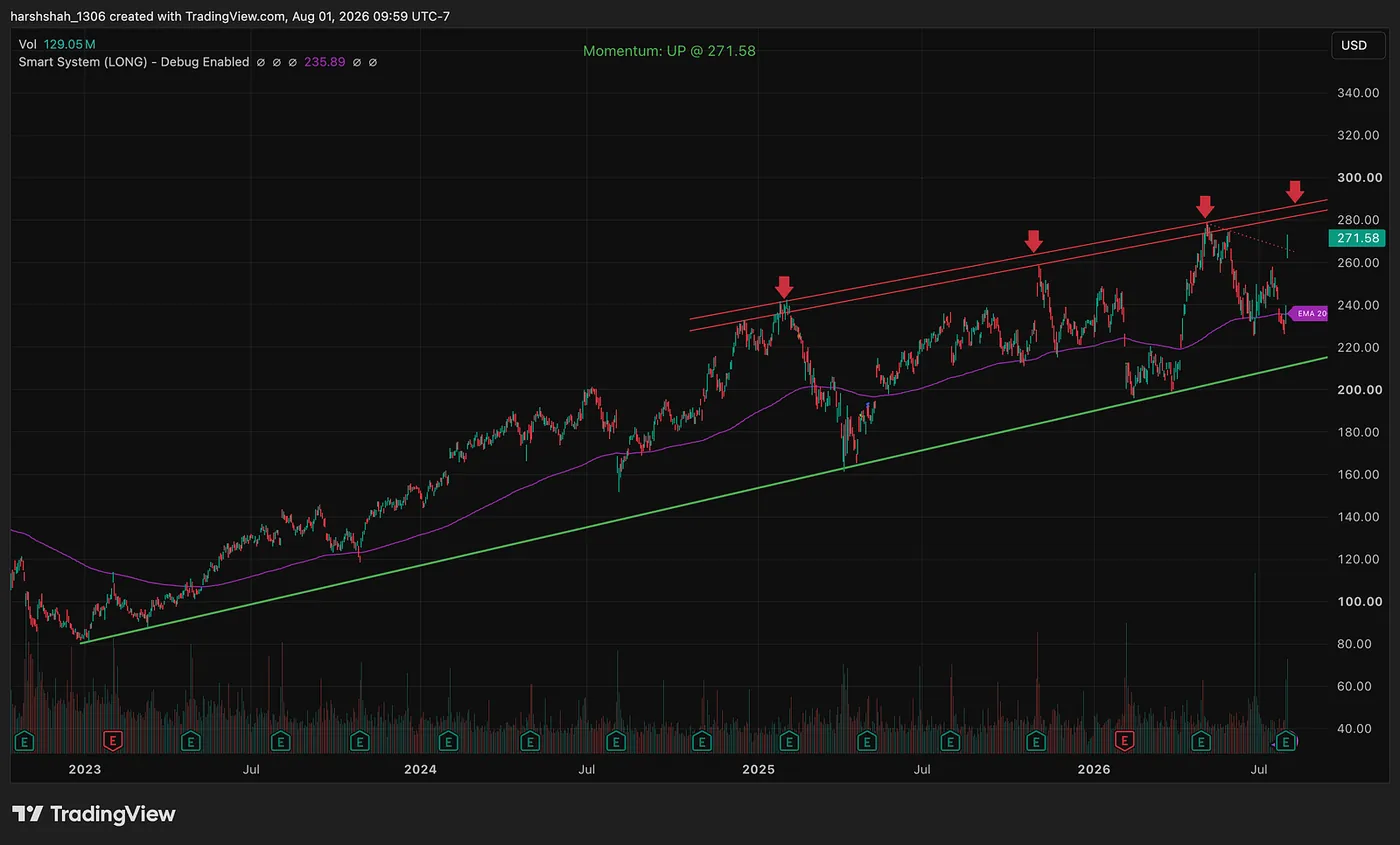
Could I have made more money by simply buying the shares? Absolutely.
But that’s not how I evaluate my decisions.
When I entered the trade, I didn’t know what Amazon would do next. After a nearly 15% earnings gap, there was a real possibility of a pullback. By selling the covered call, I paid a small price to hedge that uncertainty.
In hindsight, Choice 1 produced a better return. But I’m perfectly happy with my decision because I followed my plan, managed my risk, and still generated nearly $1,000 in premium.
Good investing isn’t about maximizing every trade — it’s about making disciplined decisions based on the information you have at the time.
Want to See Setups Like This Before They Happen?
The Amazon trade wasn’t about predicting the future — it was about having a plan before the market opened.
That’s exactly what I share inside the Data Driven Investing Premium Discord.
Throughout the week, I share the charts I’m watching, important support and resistance levels, high-probability technical setups, and the tools I use to analyze them. More importantly, I explain why a setup is interesting, what could invalidate it, and how I think about the risk-reward.
Inside the community, you’ll get access to:
- 📈 High-probability chart setups as they develop
- 🎯 Key technical levels and market structure
- 🛠️ The Technical Analysis tools and frameworks I use
- 💡 Educational insights to help you become a better investor
- 💬 A community focused on learning and investing with discipline
I don’t provide buy or sell signals, because every investor has a different portfolio, risk tolerance, and time horizon. My goal is to share how I analyze a setup, so you can decide whether it fits your own investing plan.
Learn the process. Understand the probabilities. Invest with conviction.
Join here.
Final Thoughts
The purpose of this article wasn’t to show how I made nearly $1,000 in a single trade. It was to show the thinking behind the decision.
I didn’t know where Amazon would go after earnings, and I didn’t pretend to. Instead, I built a position that aligned with my long-term investment thesis while managing the short-term uncertainty.
That’s the biggest lesson I’ve learned over the years: great investing isn’t about predicting the future — it’s about making decisions where the probabilities are in your favor.
Sometimes you’ll make less than the maximum possible return. That’s okay. Risk management often comes at a cost, and I’m happy to pay that cost if it helps me invest with more confidence and discipline.
At the end of the day, consistency beats perfection. If you can make good decisions over and over again, the results will eventually take care of themselves.