How I Use Options and Technical Analysis to Generate ~$2K Monthly (Part 5/5)
By Harsh Shah · Updated
Disclaimer: This content is for educational purposes only and should not be considered financial advice.
Before reading further, make sure you’re read the first four parts.
Part 1: Understanding Options
Part 2: Understanding Puts Introduction
Part 3: Cash Secured Puts vs Margin
Part 4: Stock and Strike Price
Any strategy that claims to “work” must survive bad markets.
Selling put options is no different.
When you sell a put, you are making a simple promise:
“If this stock drops to this price, I will buy it.”
So this is not speculation — it is a conditional purchase.
You are getting paid to agree to buy something at a price you already like.
The only question is:
What happens when things go very wrong?
To answer that, let’s meet two investors.
Meet Tom and Harry
Tom is fully invested.
His money is tied up in ETFs and high-quality stocks he plans to hold for years.
Harry keeps a lot of cash.
He likes to wait for bargains and buy stocks after big drops.
Both want to generate income from selling put options.
But because their portfolios are different, they must use very different risk controls.
Let’s see how.
Tom — The Margin User w/ no Cash
Tom uses margin.
That means he can sell puts using his portfolio as collateral instead of holding cash.
But Tom is disciplined.
Before selling any put, he runs through a checklist:
• He only sells puts on stocks he would gladly own
• He avoids earnings and extreme volatility
• He tracks his margin usage
• He sells only one put per stock
• He caps total exposure (for example, no more than $100K at risk)
Let’s say Tom has a $4,00,000 portfolio.
Even if his broker allows him to sell $2 million worth of puts, Tom only uses a small fraction of that.
He limits himself to $100,000 worth of put exposure.
For instance, lets say he sells the following Puts:
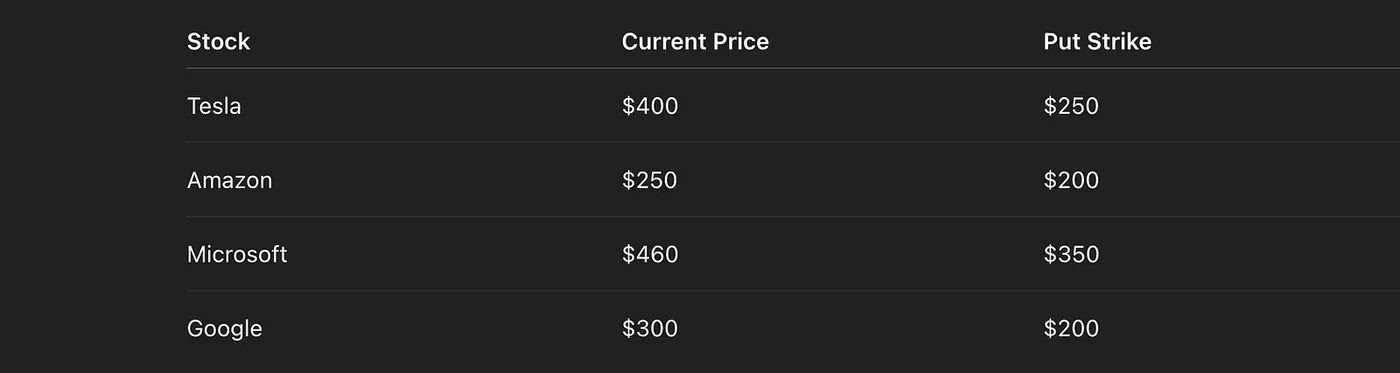
Total exposure ≈ $100,000
These are all stocks he is happy owning at those prices.
Now Imagine a Market Crash
A COVID-style crash hits.
At expiration:
• Tesla falls to $200
• Amazon falls to $180
• Microsoft falls to $300
• Google falls to $180
All of Tom’s puts are now in the money.
If he buys the put options back on the last day(if not assigned), he takes a large loss ~14,000$.
But Tom does something smarter.
He accepts assignment and buys the stocks at the agreed prices — prices he already believed were good.
Now he owns:
• Tesla at $250
• Amazon at $200
• Microsoft at $350
• Google at $200
Yes, prices are lower — but he owns quality businesses at deep discounts.
He can:
• Sell other holdings to raise cash
• Or temporarily use margin
• Or hold and let the market recover
Because Tom kept his position size small relative to his portfolio, the crash hurts — but it does not destroy him.
That’s risk management.
When Tom Wants Extra Protection
If Tom sees markets becoming unstable, he can reduce risk even further.
Instead of selling a naked put, he sells a put spread.
Example:
• Sell Tesla $250 put
• Buy Tesla $240 put
This caps his maximum loss (10K instead of 50$).
He earns less premium — but in a crash, his downside is limited.
He also uses stop rules:
If a put loses 100% of the premium, he closes or adjusts.
No hoping. No praying.
Harry — The Cash-Backed Margin Investor
Harry works a little differently.
He does use margin, but he also keeps a large amount of cash parked in money market funds, earning around 5% per year. That cash is not idle — it’s working while waiting.
When Harry sells puts, he treats them like cash-secured, even though margin is technically enabled.
If he sells a $250 Tesla put, he makes sure he has $25,000 in liquid cash equivalents ready in case of assignment.
If the market crashes:
- He simply buys Tesla at $250
- Using the cash he was already earning interest on
No forced selling.
No margin panic.
No liquidation risk.
Harry’s returns are steadier and more conservative — but he enjoys income from puts + yield on cash at the same time.
He is getting paid twice while waiting to buy great stocks at great prices.
Two Styles, Same Discipline
Tom uses margin to scale income.
Harry uses cash and money-market yields to maximize safety.
Different tools — same mindset.
Both follow the same core rules:
- Only sell puts on stocks they want to own
- Use conservative strike prices
- Avoid over-leverage
- Control position size
- Respect risk
This is what keeps them in the game when markets panic.
The Three Ways Put Sellers Actually Lose Money
Most people don’t lose money selling puts because the strategy doesn’t work.
They lose because they break one of three rules.
1. They chase premium
They sell strikes too close to price because the payout looks attractive.
That removes your margin of safety.
2. They sell too many contracts
Even good trades become dangerous when position size is too large.
Over-leverage is what blows up accounts — not one bad trade.
3. They ignore volatility and events
Selling puts into earnings, news, or macro instability is asking for trouble.
This strategy works best when markets are boring.
Almost every blown-up account fits one of these three mistakes.
How I Decide When Not to Sell Puts
Not trading is also a decision.
I avoid selling puts when:
- The market is highly volatile
- Earnings are approaching
- Price is stretched far above support
- I already have too much open exposure
Some of my best periods come from doing nothing.
Waiting for clean setups is part of the strategy.
What a “Good Month” vs a “Bad Month” Looks Like
This is important to understand.
A good month:
- Most puts expire worthless
- I keep the premium
- No assignments
A normal month:
- A few trades need rolling or adjusting
- Some small losses
- Still profitable
A bad month (rare):
- Multiple stocks drop together
- Assignments happen
- Capital gets tied up
Bad months are not failures — they are part of the distribution.
The goal is to survive them without damage.
What This Strategy Is Not
This is not:
- A get-rich-quick system
- A way to avoid risk
- A replacement for long-term investing
This is a probability-based income overlay on top of a real portfolio.
If you can’t follow rules, this won’t work.
My Framework in One Page
Everything you’ve read comes down to five things:
1. Stock Selection
Only sell puts on companies you want to own.
2. Price Selection
Sell strikes well below support.
3. Time Selection
Use 30–45 days so time decay works for you.
4. Position Size
Never let one trade or one stock control your account.
5. Risk Control
Roll, cut, hedge, or accept assignment — never hope.
That’s it.
No indicators.
No predictions.
Just structure, probability, and discipline.
Final Thoughts
Selling put options is not about being right about the market.
It’s about building a system that works when you’re wrong.
Anyone can make money when stocks go up.
The real test is what happens when fear hits, volatility spikes, and prices fall.
That’s why everything in this series has focused on:
- Stock selection
- Price discipline
- Time decay
- Position sizing
- And risk control
When you get those right, options stop feeling like gambling and start behaving like a structured business.
Some months you’ll collect easy premium.
Some months you’ll roll or adjust.
Rarely, you’ll take assignment and own great stocks at great prices.
That’s not failure — that’s the strategy working.
If you stay disciplined, avoid over-leverage, and respect risk, this approach can compound quietly in the background while your long-term portfolio does the heavy lifting.
Boring. Repeatable. Sustainable.
That’s how real money is made.