Does Technical Analysis Really Work? My Investing Strategy
By Harsh Shah · Updated
Disclaimer: This information is for educational purposes only and should not be considered financial advice.
Let’s be honest — I’m not a full-time trader sitting in front of six monitors with coffee in one hand and a stress ball in the other.
I’m a software engineer with a full-time job. I don’t have the luxury (or desire) to stare at charts all day.
What I do want is to make my money work as hard as I do.
There are countless ways to build wealth, but the one I’ve leaned toward — and learned to trust — is Technical Analysis (TA) in combination of Fundamentals because remember: no support will work if the company is fundamentally weak!
Not because it’s magic, but because it helps me make more informed and timed investing decisions.
Before I share how I personally use it, let’s talk about the three different tribes of people who use Technical Analysis — and how each one plays the game differently.
The Day Trader — The Chart Gladiator
This one’s not for the faint-hearted.
Day traders live and breathe the markets. Their screens look like NASA dashboards, and their decisions are made in seconds.
They compete with algorithms and high-frequency machines, hunting for small inefficiencies — a few cents here, a few dollars there.
If you have the time, patience, and skill to play in that arena, TA can be your greatest weapon — helping you spot liquidity zones, backtest setups, and craft razor-sharp entry and exit strategies.
But for most of us… it’s a full-time job disguised as a hobby.
(And trust me, the machines rarely take a lunch break.)
The Swing Trader — Timing the Swings
Now, this is where most part-time traders live.
Picture this — Facebook (Meta) drops from $750 to $601 within days.
Many rushed to buy at $675 thinking, “It’ll bounce back.”
Only to watch it slide another 10%. Ouch.
That’s where Technical Analysis saves you from emotional decisions.
It helps you identify support zones — areas where a bounce is more likely — and more importantly, define your stop losses and profit targets before you even hit “Buy.”
Swing trading isn’t about guessing; it’s about probability.
Your time frame? Weeks to months.
Your edge? Discipline and patience.
The Long-Term Investor — The Real Wealth Builder
You study the business — fundamentals, management, growth potential — and once you’re convinced, you turn to the chart.
Why? To decide when to build your position.
You check:
- Is it at resistance or support?
- Has it pulled back into a value zone?
- Can I scale in at Support 1, Support 2, or maybe even lower?
You’re not chasing prices. You’re strategically accumulating quality companies.
And once you buy — you don’t sell. You let time and compounding do the heavy lifting.
The Power of Compounding — Numbers Don’t Lie
Before diving into how I personally use Technical Analysis, let’s step back and look at something magical — compounding.
Here’s what happens when you invest $10,000 and let it grow over the next 30 years:
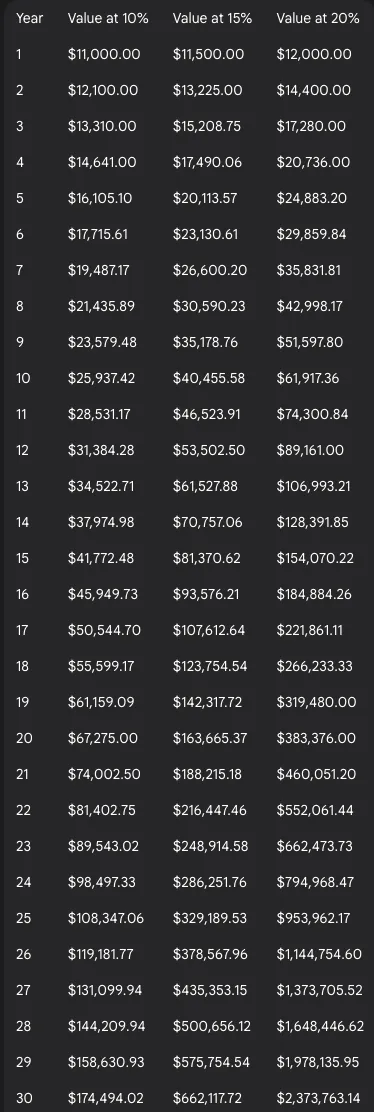
That’s the power of patience, consistency, and smart decision-making.
Note: The compounding does wonders when you’re not paying taxes.
The Real Math Behind Trading/Swing Trade Returns
Here’s something most people overlook — taxes.
As a day or swing trader, your profits are usually taxed as short-term capital gains, meaning they’re treated just like your regular income.
So if your goal is to make a 10% net return after tax, you’ll actually need to earn closer to 15% before tax to end up with that same amount in your pocket.
Now, let’s add some realistic numbers:
- Portfolio = $100,000
- Risk per trade = 5% ($5,000)
- Gain per winning trade = 10% → +$500 per trade
- Loss per losing trade = 5% → −$250 per trade
- Win rate = 80%
- Target = $15,000 (≈15% total return)
To reach your 15% annual goal ($15,000), you’d need: ~43 trades at an 80% win rate just to reach the modest 10% goal.
Just because it’s 43 trades doesn’t mean it’s easy. And an 80% win rate? That sounds almost too good to be true. You should really think this through before you start.
How I Personally Use Technical Analysis
Believe me — I’ve tried it all. Day trading, swing trading, backtesting, chasing setups — you name it.
And after years of experimenting, I’ve realized something important:
Consistently hitting even a 10% annual return through pure day or swing trading is incredibly tough — especially if you have a full-time job or other commitments.
So instead of chasing quick wins, I now follow a hybrid approach — a mix of Swing + Long-Term investing.
Here’s how it works:
- Start with fundamentally strong stocks.
Do your homework — look for solid businesses with good earnings, growth, and management.
And if deep research isn’t your thing, no problem — even a broad ETF like $SPY works just fine. - Use Technical Analysis for timing.
TA helps me decide when to enter — I avoid lump-sum buying when markets are overheated or extended.
Some investors say, “It doesn’t matter in the long run.”
Maybe. But once you truly understand price action, you’ll realize timing does improve your odds. - Swing trade while you wait.
If the market’s overbought, I don’t sit idle — I look for short-term swing setups in quality names to generate extra cash flow.
Those gains then flow back into my long-term portfolio of strong companies and ETFs. - Sell Put Options Out of the Money to collect premium.
This way, I’m not overpaying for stocks, I’m staying active, and I’m letting time and compounding quietly build my wealth in the background.
Final Thoughts
At the end of the day, Technical Analysis isn’t a magic formula — it’s a decision-making tool.
It gives you structure, clarity, and confidence when the market gets noisy.
I’ve learned that building wealth isn’t about predicting every market move — it’s about staying consistent, protecting your capital, and letting compounding quietly do its work behind the scenes.
So whether you’re a day trader chasing setups or a long-term investor waiting for value — remember this:
You don’t need to beat the market every day. You just need to avoid losing to your own emotions.