Understanding the R Framework
Overtrading? Feeling Decision Fatigue? This Simple Framework Will Change Your Trading Forever.
By Harsh Shah · Updated
Disclaimer: This information is for educational purposes only and should not be considered financial advice.
There’s a point in everyone’s journey where something finally clicks.
For years, I suffered from constant decision fatigue:
- What position size should I take?
- Where should my stop loss go?
- How do I avoid letting emotions hijack the trade?
- Am I being too safe? Too aggressive?
I still remember the day I entered a setup I absolutely loved — so I sized in big. Of course, it immediately went against me… and wiped out months of gains.
That’s when I realized something important:
My setups weren’t the problem. My decisions were.
After months of study, reflection, and practice, I finally discovered a framework that answered every one of my questions.
It won’t make you a millionaire overnight — nothing does — but it will protect your capital, bring consistency, and stop you from blowing up your account.
Let’s dive in.
The Real Problem
Have you ever heard of traders blowing up their accounts or losing thousands of dollars within minutes?
Anyone can draw trendlines, mark support zones, or memorize chart patterns.
Yet most traders still fail.
Why?
Because they’re missing the traits that actually move the needle: discipline, proper position sizing, and a real grasp of risk.
Even the strongest setup means nothing without these.
So let’s break down a step-by-step approach you can apply to every single trade.
Step 1: Separate Your Trading & Investing Accounts
This is non-negotiable.
Your long-term investments are NOT your playground.
They’re long-term for a reason.
Decide how much of your capital you’re willing to use for active trading — 1%, 10%, 15%, 25%, whatever you’re comfortable with.
For simplicity, let’s assume:
👉 Trading capital = $100,000
From my personal experience
I went long on several stocks during the tariff crash in April 2025, but ended up booking profits too early — expecting another drop — and missed out on massive rallies that followed.
Step 2: Decide Your Risk Per Trade
This is the heart of the entire strategy.
The biggest mistake traders make is thinking in terms of allocation.
Instead, you must think in terms of risk.
Ask yourself:
👉 How much am I willing to lose if one trade goes wrong? Is it 0.5%, 1% or 5% of your portfolio?
The options to start conservatively:
- $500 per trade (0.5% risk)
- $1,000 per trade (1% risk)
You don’t control profits — but you must control losses.
Step 3: Shortlist Your Setup
Use your technical/fundamental skills to pick a setup you genuinely like.
Once the stock approaches your entry zone, you’re ready for the next step.
Step 4: Define Your Stop Loss — Your “R”
This is your risk in the trade.
Most traders avoid thinking about stop losses because they don’t want to think about losing money.
But that’s exactly why they lose.
A stop loss isn’t just protection — it’s information. It tells you when your idea is invalid.
Let’s say:
Stock price = $100
Stop loss = $90
Your risk $10 — lets call this 1R.
Step 5: Define Your Reward
If you were running a business, would you accept a deal where the reward is smaller than the risk?
Absolutely not.
Same rule applies here.
The minimum reward you should expect is:
👉 At least 2R
So if 1R = $10
Then 2R = $20 profit
Your target becomes $120
Simple. Logical. Effective.
Step 6: Position Sizing
Now that you know:
- 1R = $10
- Maximum risk allowed = $1,000
Position size = $1,000 ÷ $10 = 100 shares
And that’s it.
No confusion.
No overthinking.
Just pure logic.
Another Example
Recently, I stumbled upon a penny stock with a setup so clean it almost felt irresistible.
But then the familiar doubts kicked in:
How big should my position be?
It’s a penny stock… what if I lose everything?
These questions used to paralyze me all the time.
So let’s break it down with a simple example:
- Stock price: $2
- Stop-loss: $1.90
- Risk per trade: $1,000
- Position size: $1,000 ÷ $0.10 = 10,000 shares
- Target: At least 2R, meaning around $2.20 or higher
When you look at it through the lens of risk first, it suddenly becomes straightforward.
Here’s the Magic — Putting it all together
Your win rate has a huge impact on your overall results.
Here’s a simple breakdown assuming you risk 1R on losing trades and make 2R on winning ones.
If you take around 100 trades a year, the P&L at different win rates may genuinely surprise you.
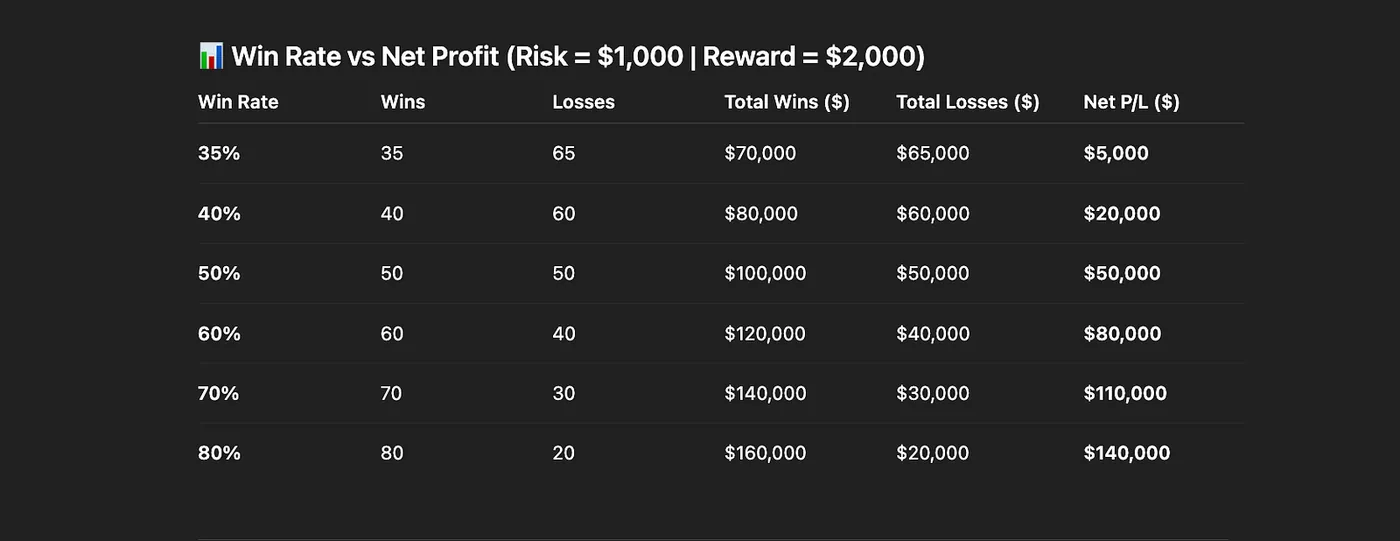
With solid Technical Analysis and disciplined risk management, achieving a 50% win rate isn’t difficult — and even at 35%, you still end up profitable.
Why I Stick to “R” Every Time
✔ Stops me from overtrading
I only enter setups where the reward justifies the risk.
✔ Protects my capital
I know my worst-case scenario before I click buy.
✔ Creates consistency
My trades are planned, not emotional.
Quick “R” Strategy Checklist
Before every trade:
✅ Identify entry
✅ Define 1R
✅ Set stop loss
✅ Calculate position size
✅ Set target in R multiples
✅ Execute with confidence
Trading doesn’t have to be chaotic.
The “R” strategy brings clarity to risk, reward, and position sizing before the trade even begins.
Start thinking in R — and watch your trading become more consistent, more disciplined, and far more profitable.
Final Thoughts
Every trader wants to find the “perfect setup,” the winning strategy, the magic indicator.
But in reality, none of that matters if your risk management is broken.
The “R” strategy didn’t just improve my trading — it gave me clarity, confidence, and control.
I stopped gambling. I stopped overthinking. I stopped blowing up weeks or months of progress with one bad trade.
And the best part?
This framework works regardless of the market, the stock, or your trading style. It forces you to think like a business owner — not a gambler.
If you commit to this approach, step by step, trade by trade…
you’ll start noticing something powerful:
You’re no longer trading to win big — you’re trading not to lose big.
And that shift alone can turn your entire journey around.
Start thinking in R.
Start valuing your risk.
Start trading with intention.
Your future self will thank you.