The Trading & Investing Framework: Portfolio Management — Part 3
By Harsh Shah · Updated
Disclaimer: This article is for educational purposes only and should not be considered financial advice.
In Part 2, we figured out who you are in the market:
- Long-term investor
- Swing trader
- Day trader
But knowing what you want to do is only half the battle.
The real question is:
How much of your capital goes where?
This is where most people fail.
They find a “hot stock,” throw 70–80% of their money into it…
…and suddenly a 5% dip feels like a heart attack.
Strategy is the engine.
Portfolio management is the brakes and the steering wheel.
Without it — you crash.
The Core & Satellite Approach
I don’t believe in going all-in.
I follow a simple framework:
Core (70–80%) → Long-Term Wealth
- Index funds / ETFs / Blue-chip stocks
- Holding period: years
- Goal: Compounding
You’re not trying to be a hero here.
You still use basic Technical Analysis:
- Avoid buying when markets are stretched
- Be more aggressive during drawdowns
Think of this as:Low effort, high consistency, slow wealth builder
Satellite (20–30%) → Active Growth
This is where things get interesting.
- Swing trading
- Growth stocks
- Technical setups
But with rules (More in the next blog):
- Fixed risk per trade of the satellite account(e.g., 1–5%)
- Structured approach
- No gambling
You’re not here to “get rich quick.”
You’re here to build skill + generate alpha over time.
Why this combination works
This split does one very important thing:
It protects you from yourself.

Even if your active trades struggle, your long-term portfolio continues compounding in the background.
At the beginning, it’ll all feel random — you’ll struggle, and your emotions will take over. But if you stay determined, you’ll eventually find a solution that works for you.
Diving Deeper into the Satellite Portfolio
If you’re just starting out, don’t jump in with full size.
Start conservative.
A good starting point:10% of your total portfolio or even less
The Obvious Question“Small size = small gains… is it even worth my time?”
Think of It Like This
If you’re starting your career:
- You study for 10–15 years
- Then begin with an entry-level role
- Based on performance, you level up (or down)
You don’t walk into your first job and become the CEO.
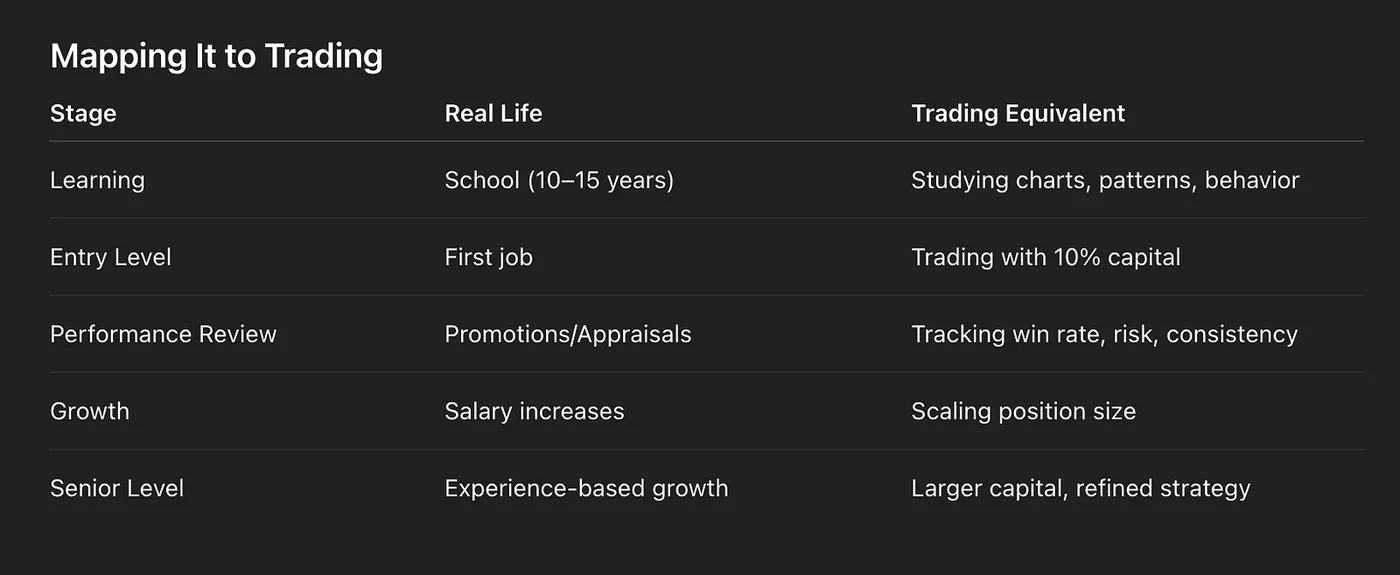
Trading Is No DifferentThis phase is your learning capital.
Your goal is not to make money immediately —
it’s to understand your edge.
What Should You Track?Before you scale, you need data.
Track simple metrics:
- Win rate → How often you’re right
- Loss rate → How often you’re wrong
- Average win vs loss
- Size of wins vs losses
- and many others
We’ll break these down properly in the coming parts.
3 Golden Principles of Allocation
1. The “Sleep Well at Night” (SWAN) Test
If you’re:
- Checking your portfolio every 10 minutes
- Thinking about trades during work
- Losing sleep over market moves
👉 Your allocation is too high.
Your trading capital should feel like this:
It would hurt if lost… but it wouldn’t change your life.
2. Separate Capital from Risk
Most beginners think:
“If I have ₹X invested, I’m risking ₹X.”
That’s not how it works.
You’re not supposed to risk your entire capital on every trade.
You’re only risking a small, controlled portion each time.
Think of it like this:
Your capital is what youhave
Your risk is what you’rewilling to lose
This is what keeps you in the game long enough to improve.
(We’ll break this down properly with numbers in the next blog.)
3. Diversification (Not “Di-worse-ification”)
More stocks ≠ more safety.
In fact, too many positions just create:
- Confusion
- Overwhelm
- Poor decision-making
Keep it simple:
- Investing: A handful of strong companies or a few broad ETFs
- Trading: Just a few high-quality setups at a time
Focus beats clutter.
✅ Action Items Before the Next Article
- Calculate your “Investable Surplus”: After your emergency fund is set, how much total capital do you actually have?
- Define your Buckets: Based on your time, what percentage goes to “Boring” (Core) and “Active” (Satellite)?
Final thoughts
Most people come into the market looking for the perfect strategy.
But the truth is:
You don’t blow up because of a bad strategy.
You blow up because of bad allocation and poor risk control.
You can have:
- The best setup
- The perfect entry
- A high win rate
…and still lose money if your sizing is wrong.
This framework is not about maximizing returns overnight.
It’s about:
- Staying in the game
- Building consistency
- Letting compounding do the heavy lifting
If you take away just one thing from this article, let it be this:
Protect your capital first. Grow it second.
What Comes Next
Allocation tells you:
“How much should I put in the market?”
But that’s only half the equation.
The real edge comes from:
“How much am I willing to lose on each bet?”
In Part 4, we’ll go deeper into:
- Risk Management
- Position sizing
- How to handle losing streaks
- Building a system that keeps you in the game
Because in trading, survival isn’t optional — it’s the strategy.