I Invested $40,000 Into Meta After a 26% Crash — Here’s Why
By Harsh Shah · Updated
Disclaimer: This information is for educational purposes only and should not be considered financial advice.
After Meta slid from $792 to $582 — a brutal 26% drop — one question immediately took center stage:
Is this a dip worth buying… or the start of something far uglier?
I’ve been tracking Meta for months. The fundamentals were strong, the growth story intact, and the long-term vision compelling. All I needed was a meaningful correction to step in with conviction.
But one thing I’ve learned over the years:
Buying just because a stock is “down 10%” is how you blow up accounts.
The real edge lies in knowing where the probability is stacked in your favor.
Why Technical Analysis Mattered Here
Corrections bring noise.
Headlines exaggerate.
Emotions take over.
Technical analysis is what keeps me grounded.
Rather than reacting to red candles, I focused on better questions:
👉 Where does true demand exist?
👉 Where have buyers repeatedly defended price?
👉 Where does the probability of a strong reversal genuinely increase?
This wasn’t about catching a falling knife.
This was about identifying the exact zone where price has a structural reason to bounce.
Before We Dive Into the Setup… A Few Key Concepts
To fully understand the 3-factor setup that triggered my entry, it helps to quickly revisit:
- Market Trends
- Gap Fills (I had already highlighted a key Meta gap in a prior blog)
- Relative Strength Index (RSI)
These three concepts played a crucial role in shaping the setup Meta eventually offered.
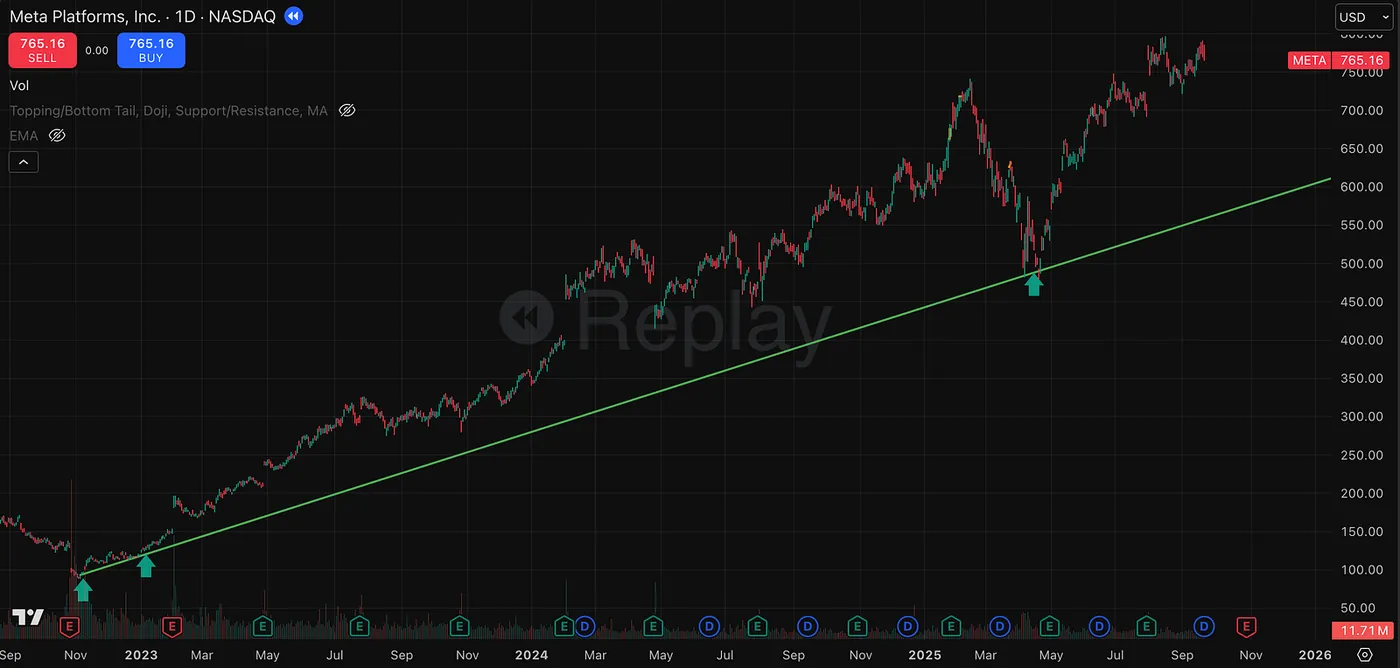
September 22 — Meta Hits ~$792
When Meta printed new all-time highs, the stock looked stretched.
Was I a buyer there? Absolutely not.
I had Meta on my watchlist, waiting patiently for a meaningful pullback. I’d been tracking a long-term uptrend line, preparing to take a position if — and only if — price retraced into that zone.
October 29 — The Earnings Drop
Post-earnings, Meta collapsed from $750 to $650 in a single session.
And that told me one thing:
It was finally moving toward a real support zone.
Exactly what I’d been waiting for.
The old me would’ve started buying right there — thinking, “Wow, it’s already down from $750, great discount!”
But the disciplined me waits for the setup.
If price doesn’t reach my level, I don’t force it.
There’s always another trade — but there’s never a good reason to abandon your system.
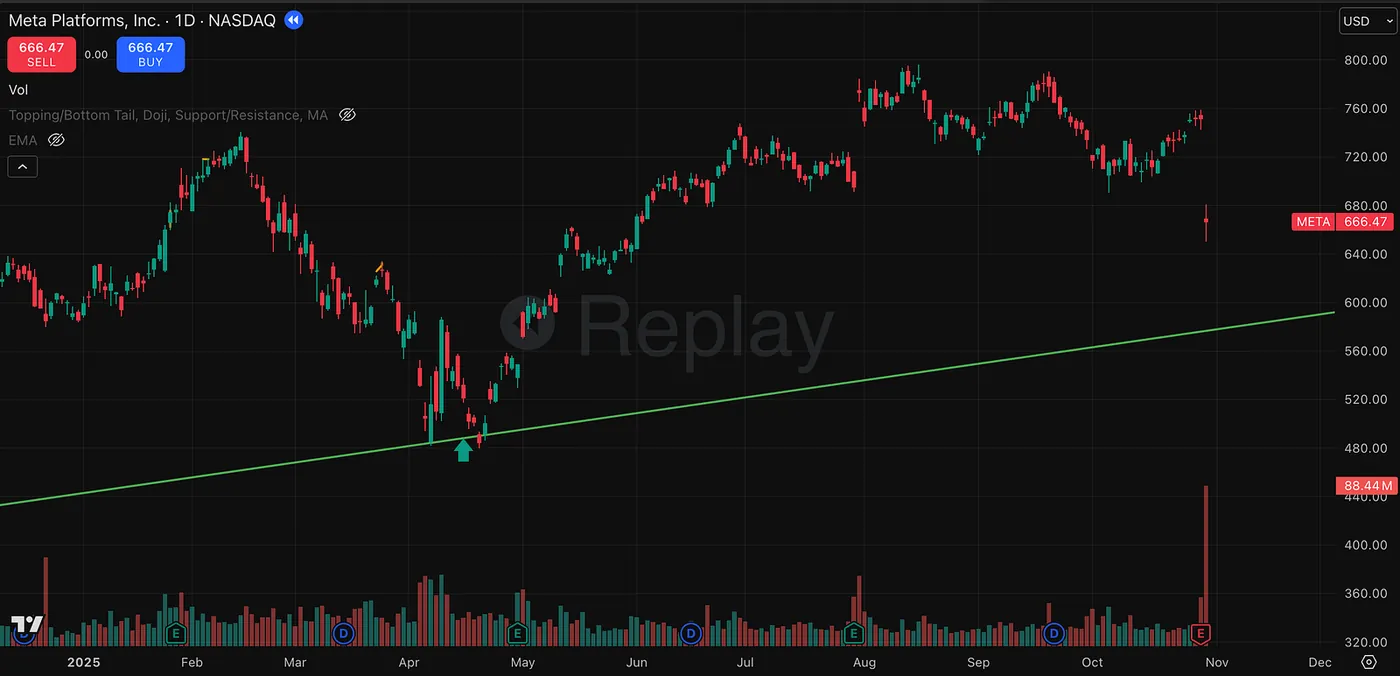
The stock plunged form 750$ to 650$ in a day post earnings. It looked like it was heading towards the support zone.
Support Zones Are Not Exact Prices
One thing the market teaches you repeatedly:
Price rarely taps support to the exact cent.
You have to think in zones, not exact numbers.
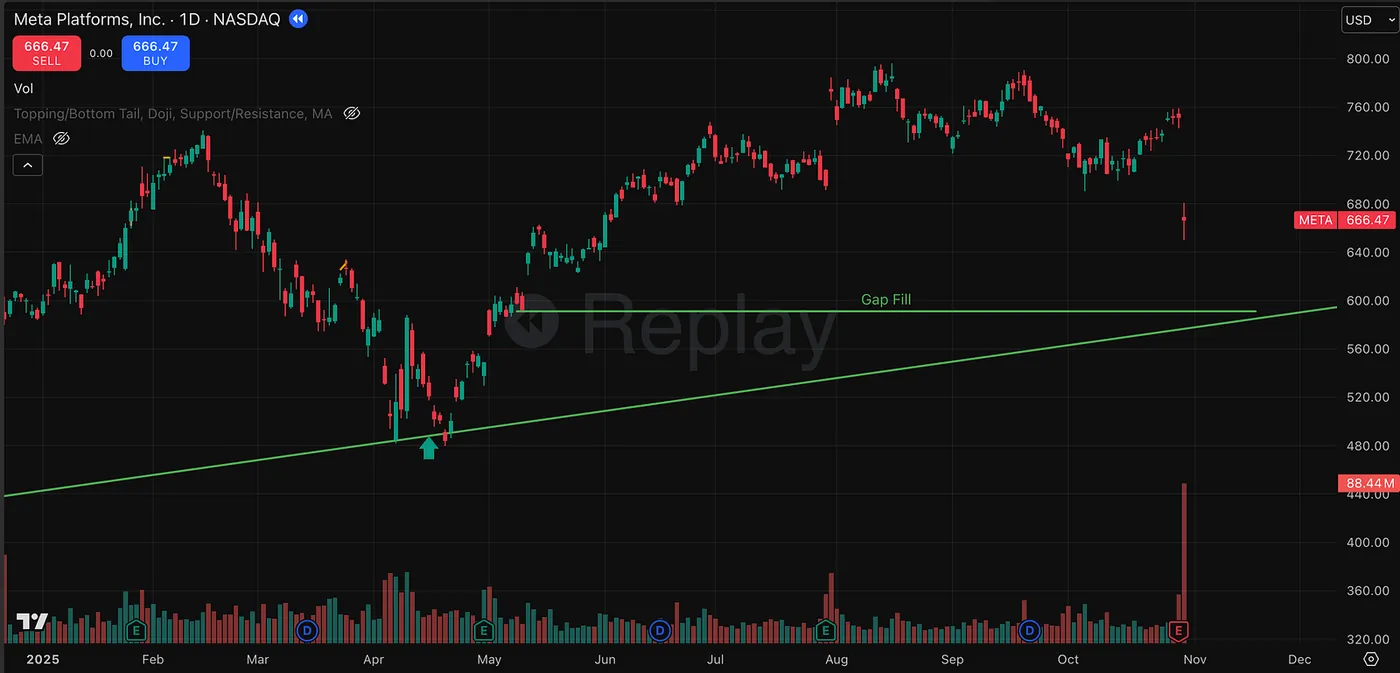
Digging deeper, I found something interesting: A major gap-fill zone around $590.
That became my ideal buy level.
November 18 — The 3-Factor Setup Finally Triggered
And then… it happened.
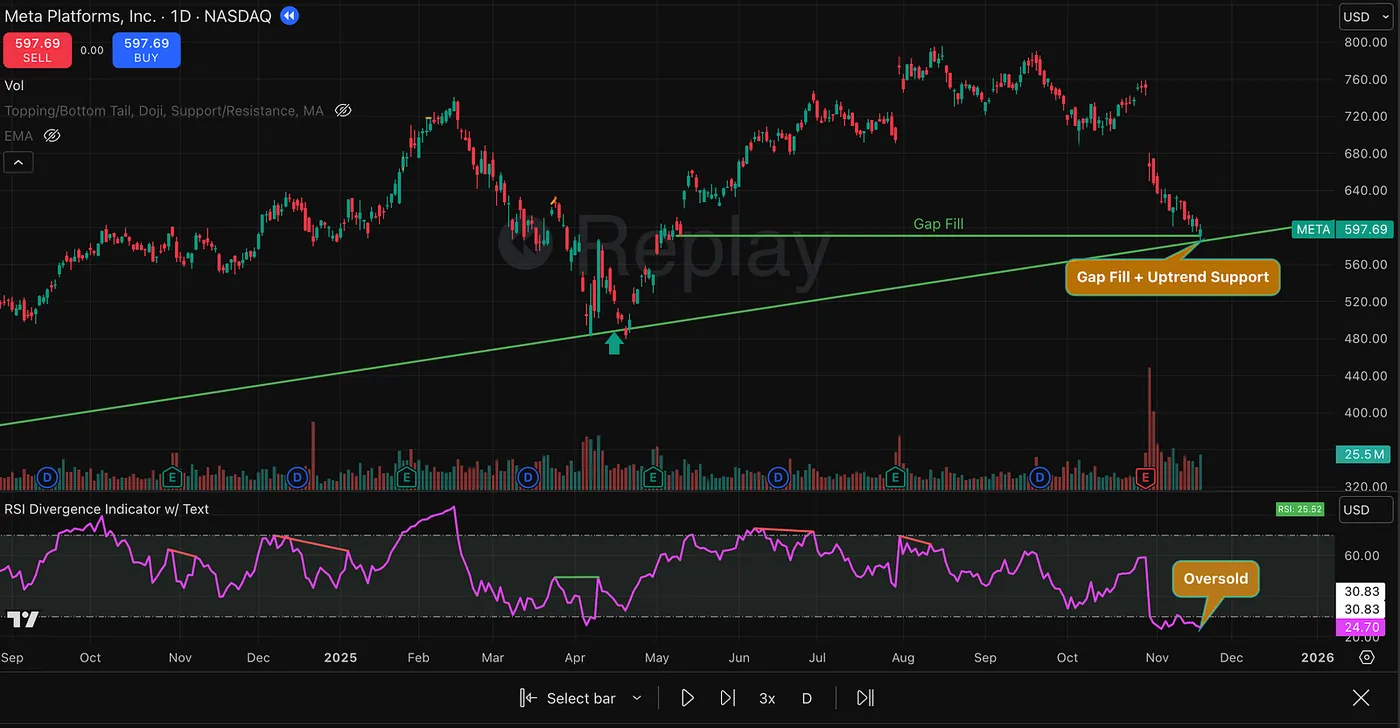
Meta pulled right into:
✔ The long-term trendline
✔ The gap fill zone I’d marked months earlier
✔ An oversold RSI signaling exhaustion
A rare, high-conviction alignment. This was the precise setup I’d been patiently waiting for.
So I acted.
I accumulated over $50,000 worth of Meta, averaging in at $590, adding a meaningful position to my long-term portfolio.
What if Meta had dropped even further?
Technical analysis is never certainty — it’s probability. This time, the demand zone held perfectly and gave a clean bounce. But if it hadn’t, I was ready for that outcome too.
My plan was simple: add more at the next gap-fill or support levels, knowing Meta’s fundamentals are still outstanding. When the underlying business is strong, I’m comfortable scaling in and holding through volatility.
Even though the position is currently up about $3,000, I’m not selling — this wasn’t a swing trade. This is a long-term conviction play.
Final Thoughts
Buying fear is never easy — but that’s exactly why it works.
This Meta dip wasn’t random volatility. It was a rare alignment of:
✔ Oversold sentiment
✔ Trendline support
✔ A major gap fill
When high-quality companies revisit strong demand zones, I act with conviction — and this time, conviction meant going big.
Long term, I believe this will be one of those entries that looks obvious in hindsight.