The Trading & Investing Framework: Setting Realistic Expectations — Part 11
By Harsh Shah · Updated
Disclaimer: This article is for educational purposes only and should not be considered financial advice.
In Part 10, we talked about journaling — because tracking your trades is what separates those who improve from those who repeat the same mistakes forever.
Now we reach the final part of this series.
And honestly?
This might be the most important one.
Not because it’s the most technical.
But because without this foundation — everything else falls apart.
🔥 The Real Reason Most People Quit
Ask yourself something honest:
Why do so many people abandon trading within the first 6 months?
It’s not because they lacked a strategy. It’s not because the market is unfair.
It’s because their expectations were never realistic to begin with.
They saw someone on Instagram turning $1,000 into $50,000 in a month. They watched a YouTube video promising “consistent daily profits.” They assumed that if they just found the right setup — the money would follow.
And when reality hit?
They weren’t prepared for it.
So they quit.
📉 The Uncomfortable Truth About Returns
Let me share something most trading influencers won’t tell you.
Hedge funds — run by some of the smartest people in finance, with billions in resources — target 15–25% annually.
Not per month. Not per week.
Per year.
So when someone on social media promises you 10% per week…
👉 Ask yourself: why aren’t the world’s top funds doing the same?
This doesn’t mean you can’t outperform over time. It means your benchmark for success needs to be grounded in reality — not fantasy.
📈 The Math Most People Underestimate
Here’s what people miss when they chase fast returns:
The power of compounding is slow at first — and then it’s extraordinary.
Let’s say you grow your portfolio at just 20% per year:
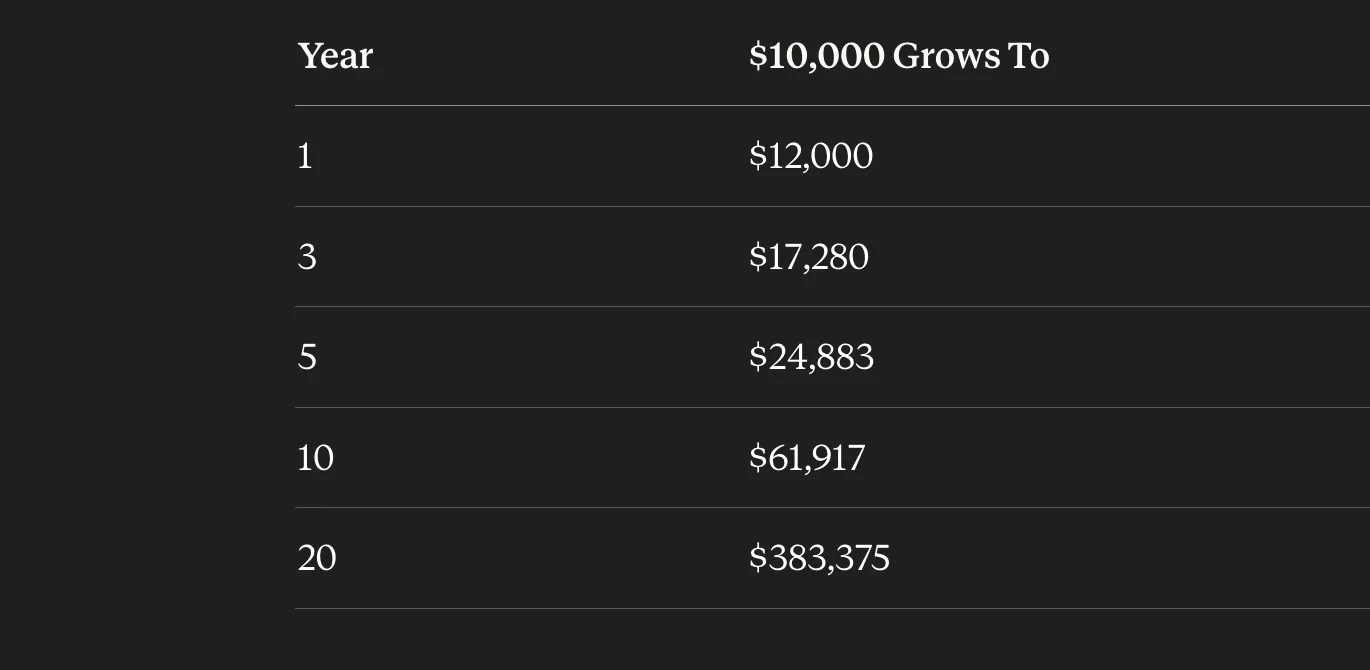
That’s without adding a single extra dollar.
That’s just compounding doing its job — quietly, consistently, over time.
Most people look at Year 1 and feel disappointed.
The ones who stay — discover what happens in Year 10.
🧠 Think Like This: Trading is a Career — Not a Lottery
When you start a new job, you don’t walk in on Day 1 and demand the highest salary.
You learn. You make mistakes. You get better. You grow — slowly, but steadily.
Active trading is no different.
Your first year is not about making money. It’s about surviving — and learning.
Your second year is about reducing mistakes.
Your third year is about building consistency.
The returns come after the process is built.
Not before.
Most people want the output before they’ve put in the work.
And the market has a very efficient way of reminding them of that.
⚠️ What Unrealistic Expectations Actually Cost You
This is something nobody talks about openly.
When your expectations are too high:
- You oversize trades to “make it back faster”
- You abandon strategies before they have time to prove themselves
- You move stop losses because you “can’t afford” to be wrong
- You jump from setup to setup, chasing the next big move
- You treat every loss as a crisis instead of a data point
👉 Unrealistic expectations don’t just hurt your returns.
They destroy your process.
And without a process — there is no edge.
🎯 What Realistic Expectations Actually Look Like
So what should you actually aim for?
In your first year:
- Preserve capital
- Build a journaling habit
- Understand your emotional patterns
- Achieve consistency in execution — not necessarily in profits
In years 2–3:
- Start refining your edge with real data
- Aim for modest, positive returns
- Focus on your win rate, expectancy, and risk management
Long term:
- Outperforming the index consistently
- Building asymmetric setups where your winners dwarf your losers
- Letting compounding carry the heavy load
That might sound slow.
But slow and consistent beats fast and reckless — every single time.
💡 The 1% Rule
Here’s something I come back to constantly:
Improve just 1% every week.
That’s it.
1% better at reading setups. 1% better at managing emotions. 1% better at following your rules.
It doesn’t feel like much in the moment.
But 1% compounded over a year is a 67% improvement.
And 1% compounded over two years?
You’re almost unrecognizable as a trader compared to where you started.
The market doesn’t reward intensity.
It rewards patience and consistency — applied over a long enough timeline.
✅ Action Items Before You Close This Article
🎯 Write down your honest 1-year goal — not in dollars, but in process milestones
📓 Commit to journaling every single trade for the next 30 days
📊 Define what “success” looks like for you at 6 months, 1 year, and 3 years
⏳ Give yourself permission to be a beginner — without shame
Because everyone who is exceptional at this was once exactly where you are now.
📚 The Complete Series — Start From the Beginning
If you found this article useful, the full framework is waiting for you.
Each part builds on the last — so I’d recommend reading them in order.
Here’s everything covered so far:
Part 5 — Building a Real Edge Fundamental vs technical analysis. Why copying gurus rarely works.
Part 6 — Trend Following Aligning with the market instead of fighting it. How to ride momentum.
Part 8 — Mean Reversion Trading When markets stretch too far — and snap back.
Part 9 — Building Your Scanner From random chart browsing to a system that finds setups for you.
Part 11 — Setting Realistic Expectations ← You are here
📖 All articles in one place: datadriveninvesting.io/blogs
The Comprehensive Technical Analysis Course Is Live
Everything in this blog series was a preview.
The course is where the real work begins.
Master Technical Analysis with 100+ Real Chart Setups. I’ve deconstructed hundreds of strategies, invested over $10,000 into my own education, and made the expensive mistakes most traders only realize after years.
This isn’t theory.
It’s a practical framework built on real market experience — combining traditional price action with AI and automation to simplify your decision-making.
11 Modules · 30+ Lessons · Real Case Studies
I strongly believe high-quality trading education should be accessible to everyone. The price reflects that.
👉 Register now:datadriveninvesting.io/course
🚀 Final Thoughts
We’ve covered a lot in this series:
- Who you are as a market participant
- How to structure your portfolio
- Risk management and position sizing
- Building an edge with real conviction
- Trend following, breakouts, and mean reversion
- Scanning for opportunities systematically
- Journaling every trade
But none of it works — if your expectations are broken from the start.
The traders who make it aren’t the ones who started with the most money.
Or the best strategy.
Or the most screen time.
They’re the ones who stayed long enough to figure it out.
👉 Stay in the game.
Build the process.
Trust the compounding.
And remember why you started.
That’s where real progress begins.
If this series helped you, consider sharing it with someone who is just starting their journey in the markets.